

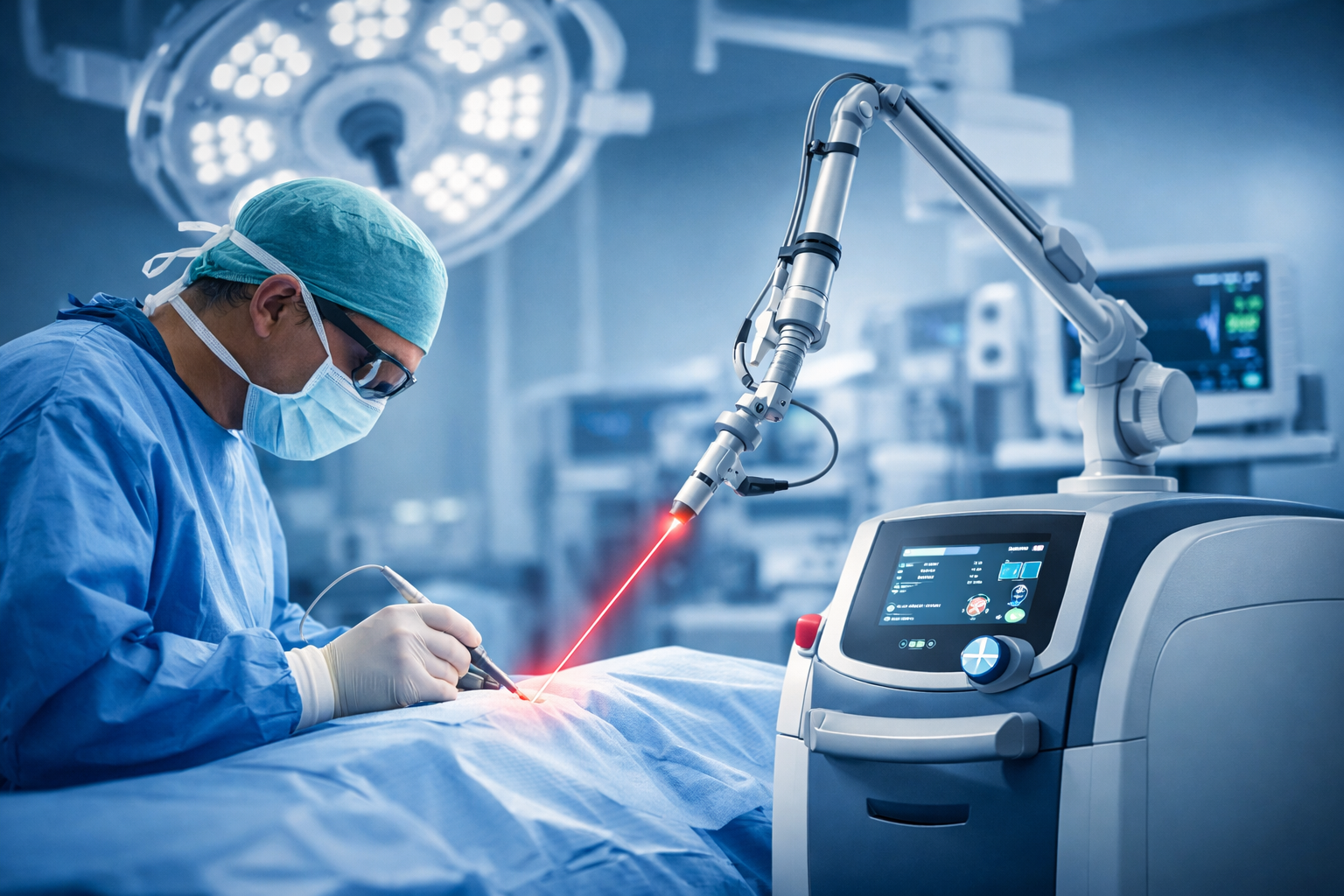
Laser surgical technology has transformed the way modern surgeons perform delicate and complex procedures. With its ability to deliver controlled light energy, laser surgery allows doctors to treat medical conditions with remarkable accuracy and minimal disruption to surrounding tissues. Below are some of the key benefits of laser-assisted surgery.
1. Enhanced Precision for Delicate Tissue Manipulation
Surgical lasers function as highly advanced precision tools, producing concentrated beams of light energy that surgeons can control at microscopic levels. When operating near sensitive structures such as nerves, blood vessels, or vital organs, this level of precision becomes extremely important. Laser energy can be finely tuned to target tissue layers only a few micrometers thick, allowing surgeons to remove diseased or damaged tissue while carefully protecting nearby healthy structures.
For example, the CO2 laser can precisely vaporize targeted tissue, enabling surgeons to perform extremely delicate procedures, including those involving the vocal cords, without harming the surrounding healthy tissue. This level of surgical accuracy was difficult to achieve with traditional surgical instruments. Another important advantage is that laser energy can seal tiny blood vessels and lymphatic channels while cutting, improving visibility and allowing surgeons to work more efficiently.
Different types of surgical lasers are designed for specific tissues and clinical purposes. Each laser uses unique wavelengths and energy delivery systems suited to particular procedures. The argon laser is highly effective for treating vascular conditions because it is easily absorbed by hemoglobin, while the Nd:YAG laser penetrates deeper layers of tissue, making it suitable for procedures that require coagulation of larger blood vessels.
2. Reduced Bleeding and Improved Surgical Outcomes
One of the most important benefits of laser surgery in the operating room is its ability to cut tissue while simultaneously sealing blood vessels. As the laser beam passes through tissue, it cauterizes small blood vessels and capillaries instantly, significantly reducing bleeding during the procedure. This hemostatic effect provides surgeons with a clearer surgical field and often decreases the need for blood transfusions.
Patients undergoing advanced laser procedures usually experience far less blood loss compared to traditional surgical methods. Reduced bleeding offers several advantages, including shorter surgical times, lower risk of complications, and improved safety for patients who may be more vulnerable to blood loss, such as elderly individuals or patients with certain medical conditions.
Another advantage of laser surgical technology is the controlled thermal effect it produces during treatment. Traditional surgical instruments can create tissue trauma through cutting and manual manipulation, which often leads to inflammation, swelling, and bruising after surgery. Laser surgery, when used correctly, minimizes this tissue trauma while still achieving the required surgical results.
Surgical Method – Comparison Table
- Traditional Surgery: Moderate to High Blood Loss, Longer Operating Time, Extended Recovery
- Laser Surgery: Minimal Blood Loss, Shorter Operating Time, Accelerated Recovery
3. Faster Tissue Healing with Minimal Damage
The interaction between laser energy and biological tissue creates favorable conditions for faster healing. Unlike mechanical surgical instruments that may cause irregular wound edges and damage nearby tissue, laser surgery produces smooth, precise incisions with very little impact on surrounding structures. The controlled thermal energy also stimulates cellular regeneration, encouraging tissues to repair more efficiently at the microscopic level.
One of the major benefits of laser surgery is the preservation of nearby healthy tissue. Because the treatment is highly targeted, the body’s natural healing process can focus on repairing the treated area instead of responding to widespread tissue trauma. As a result, many patients report less post-operative discomfort and often require fewer pain medications during their recovery period.
Certain laser wavelengths also provide antimicrobial effects that support improved healing. Laser energy can help reduce bacterial presence at the surgical site, lowering the risk of infection after surgery. This benefit is especially valuable in procedures involving areas that are more susceptible to bacterial growth, such as oral or gynecological surgical treatments.
Another advantage of minimally invasive laser surgery is reduced scar formation. Because laser incisions are extremely precise, collagen fibers tend to form in a more organized pattern during the healing process. Many patients therefore notice that surgical areas treated with laser technology heal with less visible scarring compared to conventional surgical techniques, which is particularly important for procedures performed in cosmetically sensitive areas.